Reinforcement Learning
-
Supervised learning needs labelled data. Unsupervised learning finds patterns in unlabelled data. Reinforcement learning (RL) is different from both: an agent learns by interacting with an environment, taking actions, and receiving rewards. There are no correct labels; the agent must discover good behaviour through trial and error.
-
Think of teaching a dog a new trick. You do not show it a dataset of correct behaviours. Instead, it tries things, you give treats for good actions, and over time it figures out what you want. RL formalises this process.
-
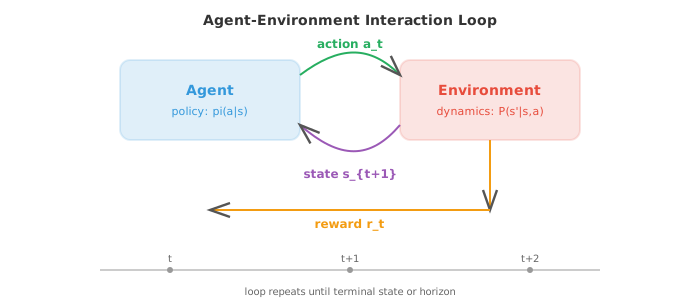
The RL setup has five core components. The agent is the learner and decision-maker. The environment is everything outside the agent that it interacts with. At each time step, the agent observes a state $s_t$, chooses an action $a_t$, receives a reward $r_t$, and transitions to a new state $s_{t+1}$. The agent's goal is to maximise the total reward it collects over time.
-
A policy $\pi$ is the agent's strategy: a mapping from states to actions. A deterministic policy gives one action per state: $a = \pi(s)$. A stochastic policy gives a probability distribution over actions: $\pi(a \mid s)$. The goal of RL is to find the optimal policy, the one that maximises expected cumulative reward.
-
The mathematical framework for RL is the Markov Decision Process (MDP), defined by a tuple $(S, A, P, R, \gamma)$: a set of states $S$, a set of actions $A$, transition probabilities $P(s' \mid s, a)$, a reward function $R(s, a)$, and a discount factor $\gamma$.
-
The Markov property (from chapter 05) says the future depends only on the current state, not on the history of how you got there: $P(s_{t+1} \mid s_t, a_t, s_{t-1}, \ldots) = P(s_{t+1} \mid s_t, a_t)$. This means the state contains all the information needed to make a decision.
-
The discount factor $\gamma \in [0, 1)$ determines how much the agent cares about future rewards versus immediate ones. The discounted return from time $t$ is:
$$G_t = r_t + \gamma r_{t+1} + \gamma^2 r_{t+2} + \cdots = \sum_{k=0}^{\infty} \gamma^k r_{t+k}$$
-
With $\gamma = 0$, the agent is completely myopic, caring only about the next reward. With $\gamma$ close to 1, the agent is far-sighted. The discount factor also ensures the sum converges (if rewards are bounded), which is important for mathematical well-definedness.
-
Value functions estimate how good it is to be in a state (or to take an action in a state). The state-value function $V^\pi(s)$ is the expected return starting from state $s$ and following policy $\pi$:
$$V^\pi(s) = \mathbb{E}_\pi \left[ G_t \mid s_t = s \right]$$
- The action-value function $Q^\pi(s, a)$ is the expected return starting from state $s$, taking action $a$, and then following $\pi$:
$$Q^\pi(s, a) = \mathbb{E}_\pi \left[ G_t \mid s_t = s, a_t = a \right]$$
-
The relationship: $V^\pi(s) = \sum_a \pi(a \mid s) , Q^\pi(s, a)$. The state value is the average of action values, weighted by the policy.
-
The Bellman equation expresses a recursive relationship: the value of a state equals the immediate reward plus the discounted value of the next state. For the state-value function:
$$V^\pi(s) = \sum_a \pi(a \mid s) \sum_{s'} P(s' \mid s, a) \left[ R(s, a) + \gamma , V^\pi(s') \right]$$
- For the optimal value function $V^{*}(s)$, the agent always picks the best action:
$$V^{}(s) = \max_a \sum_{s'} P(s' \mid s, a) \left[ R(s, a) + \gamma , V^{}(s') \right]$$
- Similarly, the Bellman optimality equation for $Q^{*}$:
$$Q^{}(s, a) = \sum_{s'} P(s' \mid s, a) \left[ R(s, a) + \gamma \max_{a'} Q^{}(s', a') \right]$$
-
Once you have $Q^{}$, the optimal policy is trivial: always pick the action with the highest Q-value: $\pi^{}(s) = \arg\max_a Q^{*}(s, a)$.
-
Dynamic programming methods solve MDPs when you know the transition probabilities and rewards (the full model). Policy evaluation computes $V^\pi$ for a given policy by iteratively applying the Bellman equation until convergence. Policy improvement takes the value function and constructs a better policy by acting greedily: $\pi'(s) = \arg\max_a \sum_{s'} P(s' \mid s, a)[R(s,a) + \gamma V^\pi(s')]$.
-
Policy iteration alternates between evaluation and improvement until the policy stops changing. It is guaranteed to converge to the optimal policy.
-
Value iteration combines both steps into one: it repeatedly applies the Bellman optimality equation until $V^{*}$ converges, then extracts the policy.
$$V(s) \leftarrow \max_a \sum_{s'} P(s' \mid s, a) \left[ R(s, a) + \gamma , V(s') \right]$$
-
Dynamic programming requires knowing $P(s' \mid s, a)$, which is often impractical. In most real problems, the agent does not know the environment's dynamics; it can only interact with it. This is where model-free methods come in.
-
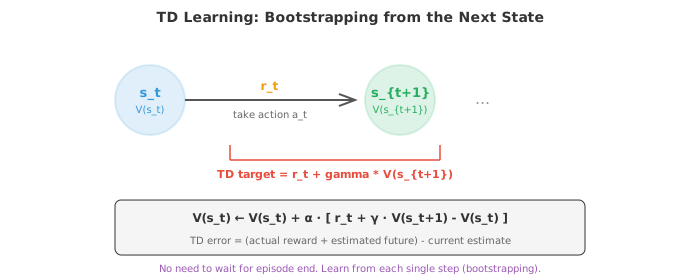
Temporal Difference (TD) learning learns from experience without knowing the model. The key idea is bootstrapping: instead of waiting until the end of an episode to compute the actual return $G_t$, you estimate it using the current value function:
$$V(s_t) \leftarrow V(s_t) + \alpha \left[ r_t + \gamma , V(s_{t+1}) - V(s_t) \right]$$
- The term in brackets is the TD error: the difference between the TD target ($r_t + \gamma V(s_{t+1})$) and the current estimate $V(s_t)$. If the TD error is positive, the state was better than expected, so we increase its value. If negative, we decrease it.
-
TD learning updates after every single step (not after complete episodes), which makes it much more efficient than Monte Carlo methods. It also works in continuing (non-episodic) environments.
-
SARSA (State-Action-Reward-State-Action) is TD learning applied to Q-values. The agent takes action $a$ in state $s$, observes reward $r$ and next state $s'$, then chooses next action $a'$ according to its policy:
$$Q(s, a) \leftarrow Q(s, a) + \alpha \left[ r + \gamma , Q(s', a') - Q(s, a) \right]$$
-
SARSA is on-policy: it updates using the action the agent actually takes, which includes exploration. This makes SARSA more conservative; it learns a policy that accounts for its own exploration noise.
-
Q-learning is the most famous RL algorithm. It is like SARSA, but instead of using the action the agent actually takes, it uses the best possible action:
$$Q(s, a) \leftarrow Q(s, a) + \alpha \left[ r + \gamma \max_{a'} Q(s', a') - Q(s, a) \right]$$
-
Q-learning is off-policy: it learns the optimal Q-values regardless of the policy being followed. The agent can explore randomly while still learning the optimal action values. This makes Q-learning more aggressive and often faster to converge, but it can overestimate values.
-
Exploration vs exploitation is the fundamental dilemma: should the agent exploit what it already knows (choose the action with the highest estimated value) or explore unknown actions (which might turn out to be better)?
-
The simplest strategy is epsilon-greedy: with probability $\epsilon$, take a random action (explore); with probability $1 - \epsilon$, take the greedy action (exploit). A common schedule starts with high $\epsilon$ (lots of exploration) and decays it over time.
-
Tabular methods (storing a value for each state-action pair in a table) work for small, discrete state spaces. For large or continuous state spaces, you need function approximation. Deep Q-Networks (DQN) use a neural network to approximate $Q(s, a; \theta)$, where $\theta$ are the network weights.
-
DQN introduced two critical stabilisation techniques. Experience replay: instead of learning from consecutive transitions (which are highly correlated), store transitions in a replay buffer and sample random mini-batches for training. This breaks correlations and reuses data efficiently.
-
Target network: use a separate, slowly-updated copy of the network to compute TD targets. Without this, the target moves every time you update the network, creating a "chasing your own tail" instability. The target network is updated periodically (hard update every $N$ steps) or continuously (soft update: $\theta^{-} \leftarrow \tau\theta + (1-\tau)\theta^{-}$).
-
The DQN loss is just MSE between predicted Q-values and TD targets:
$$\mathcal{L}(\theta) = \mathbb{E} \left[ \left( r + \gamma \max_{a'} Q(s', a'; \theta^{-}) - Q(s, a; \theta) \right)^2 \right]$$
-
All the methods so far learn value functions and derive policies from them. Policy gradient methods take a different approach: they directly parameterise the policy $\pi(a \mid s; \theta)$ and optimise it by gradient ascent on expected return.
-
The policy gradient theorem gives the gradient of expected return with respect to policy parameters:
$$\nabla_\theta J(\theta) = \mathbb{E}\pi \left[ \nabla\theta \log \pi(a \mid s; \theta) \cdot G_t \right]$$
-
This says: increase the probability of actions that led to high returns, decrease the probability of actions that led to low returns. The log-probability gradient gives the direction to change the policy, and $G_t$ scales how much to change it.
-
REINFORCE is the simplest policy gradient algorithm. Run an episode, compute returns $G_t$ for each step, and update:
$$\theta \leftarrow \theta + \alpha , \nabla_\theta \log \pi(a_t \mid s_t; \theta) \cdot G_t$$
- REINFORCE has high variance because $G_t$ is a noisy, single-sample estimate of the expected return. A common fix is to subtract a baseline (typically the average return or a learned value function) to reduce variance without introducing bias:
$$\theta \leftarrow \theta + \alpha , \nabla_\theta \log \pi(a_t \mid s_t; \theta) \cdot (G_t - b)$$
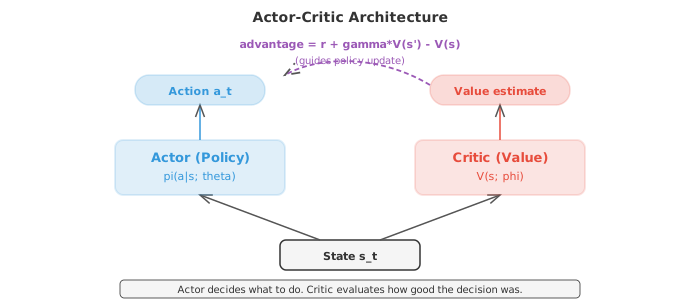
- Actor-Critic methods use two networks. The actor is the policy $\pi(a \mid s; \theta)$. The critic is a value function $V(s; \phi)$ that serves as the baseline. The advantage $A_t = r_t + \gamma V(s_{t+1}) - V(s_t)$ replaces $G_t - b$:
$$\theta \leftarrow \theta + \alpha , \nabla_\theta \log \pi(a_t \mid s_t; \theta) \cdot A_t$$
- The critic is updated by minimising TD error, just like value-based methods. The actor is updated using the policy gradient, with the critic's advantage estimate reducing variance. This is the best of both worlds.
-
PPO (Proximal Policy Optimization) is the most widely used policy gradient algorithm in practice. It addresses a key problem: if a policy update is too large, performance can collapse catastrophically.
-
PPO uses a clipped surrogate objective. Let $r_t(\theta) = \frac{\pi(a_t | s_t; \theta)}{\pi(a_t | s_t; \theta_{\text{old}})}$ be the probability ratio between new and old policies. The loss is:
$$\mathcal{L}^{\text{CLIP}}(\theta) = \mathbb{E} \left[ \min!\left( r_t(\theta) A_t, ; \text{clip}(r_t(\theta), 1-\epsilon, 1+\epsilon) A_t \right) \right]$$
-
The clipping (typically $\epsilon = 0.2$) prevents the ratio from moving too far from 1, which keeps updates small and stable. If the advantage is positive (action was good), the ratio is capped at $1 + \epsilon$. If negative (action was bad), the ratio is capped at $1 - \epsilon$. This is simpler and more stable than earlier trust-region methods (TRPO).
-
PPO is what was used to train ChatGPT-style models via RLHF (Reinforcement Learning from Human Feedback). In RLHF, a reward model is trained on human preference data (which of two outputs do humans prefer?), and then PPO optimises the language model's policy to maximise this learned reward.
-
DPO (Direct Preference Optimization) simplifies RLHF by eliminating the reward model entirely. Instead of training a reward model and then running RL, DPO derives a closed-form loss that directly optimises the policy from preference data:
$$\mathcal{L}{\text{DPO}}(\theta) = -\mathbb{E} \left[ \log \sigma!\left( \beta \log \frac{\pi\theta(y_w \mid x)}{\pi_{\text{ref}}(y_w \mid x)} - \beta \log \frac{\pi_\theta(y_l \mid x)}{\pi_{\text{ref}}(y_l \mid x)} \right) \right]$$
-
Here $y_w$ is the preferred (winning) response and $y_l$ is the dispreferred (losing) response. DPO increases the relative probability of preferred outputs and is much simpler to implement than PPO-based RLHF.
-
Two important distinctions in RL algorithms. On-policy vs off-policy: on-policy methods (SARSA, PPO) learn from data generated by the current policy; off-policy methods (Q-learning, DQN) can learn from data generated by any policy. Off-policy methods are more sample-efficient (they reuse old data) but can be less stable.
-
Model-based vs model-free: model-free methods (everything discussed so far) learn values or policies directly from experience. Model-based methods learn a model of the environment ($P(s' \mid s, a)$ and $R(s, a)$) and use it for planning (imagining future trajectories without actually taking actions). Model-based methods are more sample-efficient but add the complexity of learning an accurate model.
-
To summarise the RL landscape:
| Method | Type | Key Idea | Strength |
|---|---|---|---|
| Value Iteration | DP, model-based | Bellman optimality | Exact solution (small MDPs) |
| SARSA | TD, on-policy | Learn Q on-policy | Conservative, safe |
| Q-Learning | TD, off-policy | Learn Q*, greedy target | Simple, effective |
| DQN | Deep, off-policy | Neural Q + replay + target net | Scales to high-dim states |
| REINFORCE | Policy gradient | Gradient of log-prob * return | Simple policy optimisation |
| Actor-Critic | PG + value | Actor + critic for low variance | Practical and flexible |
| PPO | PG, clipped | Trust-region-like stability | Industry standard |
| DPO | Direct preference | Skip reward model | Simpler RLHF |
Coding Tasks (use CoLab or notebook)
- Implement value iteration for a simple gridworld. Compute the optimal value function and extract the optimal policy. Visualise both as a heatmap and arrow plot.
import jax.numpy as jnp
import matplotlib.pyplot as plt

# 4x4 gridworld: goal at (3,3), reward -1 per step, 0 at goal
grid_size = 4
gamma = 0.99
goal = (3, 3)

# Actions: up, down, left, right
actions = [(-1, 0), (1, 0), (0, -1), (0, 1)]
action_names = ['up', 'down', 'left', 'right']
action_arrows = ['\u2191', '\u2193', '\u2190', '\u2192']

def step(s, a):
    """Deterministic transition."""
    ns = (max(0, min(grid_size-1, s[0]+a[0])),
          max(0, min(grid_size-1, s[1]+a[1])))
    return ns

# Value iteration
V = jnp.zeros((grid_size, grid_size))
for iteration in range(100):
    V_new = jnp.array(V)
    for i in range(grid_size):
        for j in range(grid_size):
            if (i, j) == goal:
                continue
            values = []
            for a in actions:
                ns = step((i, j), a)
                values.append(-1 + gamma * float(V[ns[0], ns[1]]))
            V_new = V_new.at[i, j].set(max(values))
    if jnp.max(jnp.abs(V_new - V)) < 1e-6:
        print(f"Converged in {iteration+1} iterations")
        break
    V = V_new

# Extract policy
policy = [['' for _ in range(grid_size)] for _ in range(grid_size)]
for i in range(grid_size):
    for j in range(grid_size):
        if (i, j) == goal:
            policy[i][j] = 'G'
            continue
        best_a = max(range(4), key=lambda a: -1 + gamma * float(V[step((i,j), actions[a])[0], step((i,j), actions[a])[1]]))
        policy[i][j] = action_arrows[best_a]

fig, axes = plt.subplots(1, 2, figsize=(10, 4))
im = axes[0].imshow(V, cmap='YlOrRd_r')
axes[0].set_title("Optimal Value Function")
for i in range(grid_size):
    for j in range(grid_size):
        axes[0].text(j, i, f"{V[i,j]:.1f}", ha='center', va='center', fontsize=10)
plt.colorbar(im, ax=axes[0])

axes[1].imshow(jnp.ones((grid_size, grid_size)), cmap='Greys', vmin=0, vmax=2)
axes[1].set_title("Optimal Policy")
for i in range(grid_size):
    for j in range(grid_size):
        axes[1].text(j, i, policy[i][j], ha='center', va='center', fontsize=18)
plt.tight_layout(); plt.show()
- Implement tabular Q-learning on a simple gridworld. Train the agent, plot the learning curve, and show the learned Q-values.
import jax
import jax.numpy as jnp
import matplotlib.pyplot as plt

grid_size = 5
goal = (4, 4)
actions = [(-1,0), (1,0), (0,-1), (0,1)]

# Q-table
Q = {}
for i in range(grid_size):
    for j in range(grid_size):
        Q[(i,j)] = [0.0] * 4

alpha = 0.1
gamma = 0.95
epsilon = 1.0
epsilon_decay = 0.995
min_epsilon = 0.01

def step(s, a_idx):
    a = actions[a_idx]
    ns = (max(0, min(grid_size-1, s[0]+a[0])),
          max(0, min(grid_size-1, s[1]+a[1])))
    r = 0.0 if ns == goal else -1.0
    done = ns == goal
    return ns, r, done

key = jax.random.PRNGKey(42)
rewards_per_episode = []

for ep in range(500):
    s = (0, 0)
    total_reward = 0
    for _ in range(100):
        key, subkey = jax.random.split(key)
        if float(jax.random.uniform(subkey)) < epsilon:
            key, subkey = jax.random.split(key)
            a = int(jax.random.randint(subkey, (), 0, 4))
        else:
            a = max(range(4), key=lambda i: Q[s][i])

        ns, r, done = step(s, a)
        total_reward += r
        # Q-learning update
        Q[s][a] += alpha * (r + gamma * max(Q[ns]) - Q[s][a])
        s = ns
        if done:
            break
    rewards_per_episode.append(total_reward)
    epsilon = max(min_epsilon, epsilon * epsilon_decay)

plt.figure(figsize=(8, 4))
# Smooth the curve
window = 20
smoothed = [sum(rewards_per_episode[max(0,i-window):i+1])/min(i+1, window)
            for i in range(len(rewards_per_episode))]
plt.plot(smoothed, color='#3498db', linewidth=1.5)
plt.xlabel("Episode"); plt.ylabel("Total Reward (smoothed)")
plt.title("Q-Learning on Gridworld")
plt.grid(alpha=0.3); plt.show()

# Show learned policy
arrow = ['\u2191', '\u2193', '\u2190', '\u2192']
print("Learned policy:")
for i in range(grid_size):
    row = ""
    for j in range(grid_size):
        if (i,j) == goal:
            row += " G "
        else:
            row += f" {arrow[max(range(4), key=lambda a: Q[(i,j)][a])]} "
    print(row)
- Implement REINFORCE on a multi-armed bandit problem. Show how the policy evolves over training to favour the best arm.
import jax
import jax.numpy as jnp
import matplotlib.pyplot as plt

# 5-armed bandit with different expected rewards
true_rewards = jnp.array([0.2, 0.5, 0.8, 0.3, 0.1])
n_arms = len(true_rewards)

# Policy: softmax over logits
logits = jnp.zeros(n_arms)
lr = 0.1
key = jax.random.PRNGKey(42)

policy_history = []
reward_history = []

for step in range(2000):
    probs = jax.nn.softmax(logits)
    policy_history.append(probs)

    # Sample action
    key, subkey = jax.random.split(key)
    action = jax.random.choice(subkey, n_arms, p=probs)

    # Get reward (Bernoulli)
    key, subkey = jax.random.split(key)
    reward = float(jax.random.uniform(subkey) < true_rewards[action])
    reward_history.append(reward)

    # REINFORCE update
    # grad log pi(a) = e_a - probs (for softmax parameterisation)
    grad_log_pi = -probs.at[action].add(1.0)  # one-hot(a) - probs
    logits = logits + lr * reward * grad_log_pi

policy_history = jnp.stack(policy_history)

fig, axes = plt.subplots(1, 2, figsize=(12, 4))
colors = ['#3498db', '#e74c3c', '#27ae60', '#9b59b6', '#f39c12']
for i in range(n_arms):
    axes[0].plot(policy_history[:, i], color=colors[i],
                 label=f'Arm {i} (true={true_rewards[i]:.1f})', linewidth=1.5)
axes[0].set_xlabel("Step"); axes[0].set_ylabel("P(arm)")
axes[0].set_title("Policy Evolution (REINFORCE)")
axes[0].legend(fontsize=8); axes[0].grid(alpha=0.3)

# Smoothed reward
window = 50
smoothed = [sum(reward_history[max(0,i-window):i+1])/min(i+1,window)
            for i in range(len(reward_history))]
axes[1].plot(smoothed, color='#27ae60', linewidth=1.5)
axes[1].axhline(y=0.8, color='#e74c3c', linestyle='--', alpha=0.5, label='Best arm')
axes[1].set_xlabel("Step"); axes[1].set_ylabel("Avg Reward")
axes[1].set_title("Reward Over Time"); axes[1].legend()
axes[1].grid(alpha=0.3)
plt.tight_layout(); plt.show()